
For a price comparison website, SEO is less about “publishing blog content” and more about building scalable, high-intent landing pages, trust, and structured comparison data. This is one of the most competitive SEO categories in the UK, with SERPs dominated by massive brands.
A comparison site has to compete on three fronts at once: non-brand search demand, trust, and UX that converts users into quote or comparison actions quickly. In practice, that means fast indexable templates, strong topical authority, structured comparison data, accurate product feeds, and conversion-focused landing pages.
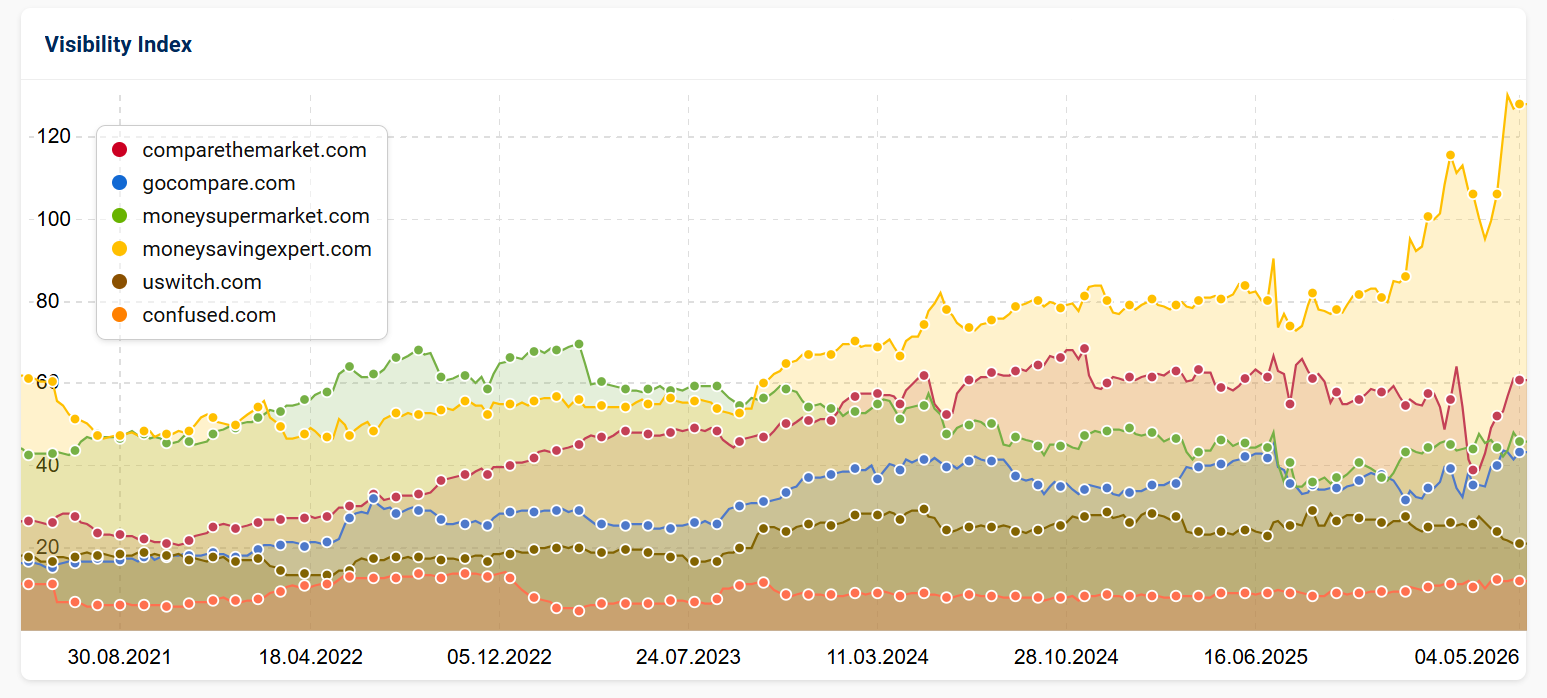
The biggest players in the UK are:
However, the SEO landscape has evolved significantly in recent years. While traditional comparison brands like Compare the Market, Go.Compare, and MoneySuperMarket still dominate commercial comparison journeys, visibility trends increasingly show strong growth from editorial-led finance publishers and trust-based content ecosystems, most notably MoneySavingExpert, which has combined expert-led content, community trust, and educational resources to become a dominant force in the space.
This highlights an important shift in modern comparison SEO: informational trust and topical authority are becoming just as important as comparison functionality itself.
SEO for Price Comparison Websites: Complete Guide
SEO for these aggregator giants is a massive undertaking. We are not talking about simple keyword optimisation. We are talking about programmatic SEO, massive authority building, and extreme technical optimisation. The model is very different from e-commerce SEO. You need to win on commercial intent, trust, and freshness simultaneously.
To compete at this level, you need to master these pillars:
- Start with a clear niche before going broad
- Build category authority with hub-and-spoke architecture
- Build pages around comparison intent keywords
- Comparison tables are your SEO product pages
- Capture long-tail and informational queries
- Programmatic SEO at scale
- Technical SEO and crawl efficiency
- Data accuracy and feed management
- E-E-A-T, editorial authority, and trust
- Brand authority and Digital PR
- Schema markup and structured data
- Optimising for AI Overviews and SGE
- Content freshness and ongoing maintenance
- Measure SEO by business outcome, not just rankings
1. Start with a clear niche before going broad
If you are launching a new price comparison website, avoid trying to compete with the biggest players immediately.
It is usually better to start with a specific niche where you can build authority faster, such as eco-friendly insurance, electric vehicle finance, mechanical keyboards, sustainable utilities, or fashion price comparison.
This allows you to create deeper content, stronger comparison pages, more relevant backlinks, and a clearer brand position before expanding into broader categories.
Purely transactional comparison sites are also becoming easier to replicate. What is harder to replicate is trust, editorial authority, community engagement, and genuine specialist expertise, all of which compound faster within a defined niche.
Real-world example: MoneySavingExpert is a strong example of building authority through a clear trust-led niche before expanding. It started from a money-saving and consumer advice position, then grew into areas such as broadband, energy, credit cards, insurance, banking, and loans. The lesson is that trust and topical expertise can become the platform for comparison growth, rather than comparison functionality alone.
2. Build category authority with hub-and-spoke architecture
The best comparison sites are structured around product silos and topic clusters.
The hub page targets the main commercial term, while supporting pages target subtopics, FAQs, pricing questions, eligibility, exclusions, and use-case content.
Example structure:
- Core comparison page → Compare car insurance
- Supporting guides → Best car insurance for young drivers
- Pricing content → Average cost of car insurance UK
- Educational content → What affects car insurance premiums?
- FAQ/glossary pages → Excess meaning, black box insurance explained
This creates topical authority and funnels internal link equity into commercial comparison pages. Instead of one generic blog, comparison sites should organise guides by product vertical (car insurance, home insurance, broadband, energy, finance) so each category has its own self-contained content ecosystem.
The commercial comparison pages capture demand. The supporting content hub builds the authority that makes those commercial pages rank in the first place. Avoid generic or duplicated manufacturer descriptions on supporting pages. Unique commentary, expert perspective, pros and cons, and user review data make these pages more useful and more indexable.
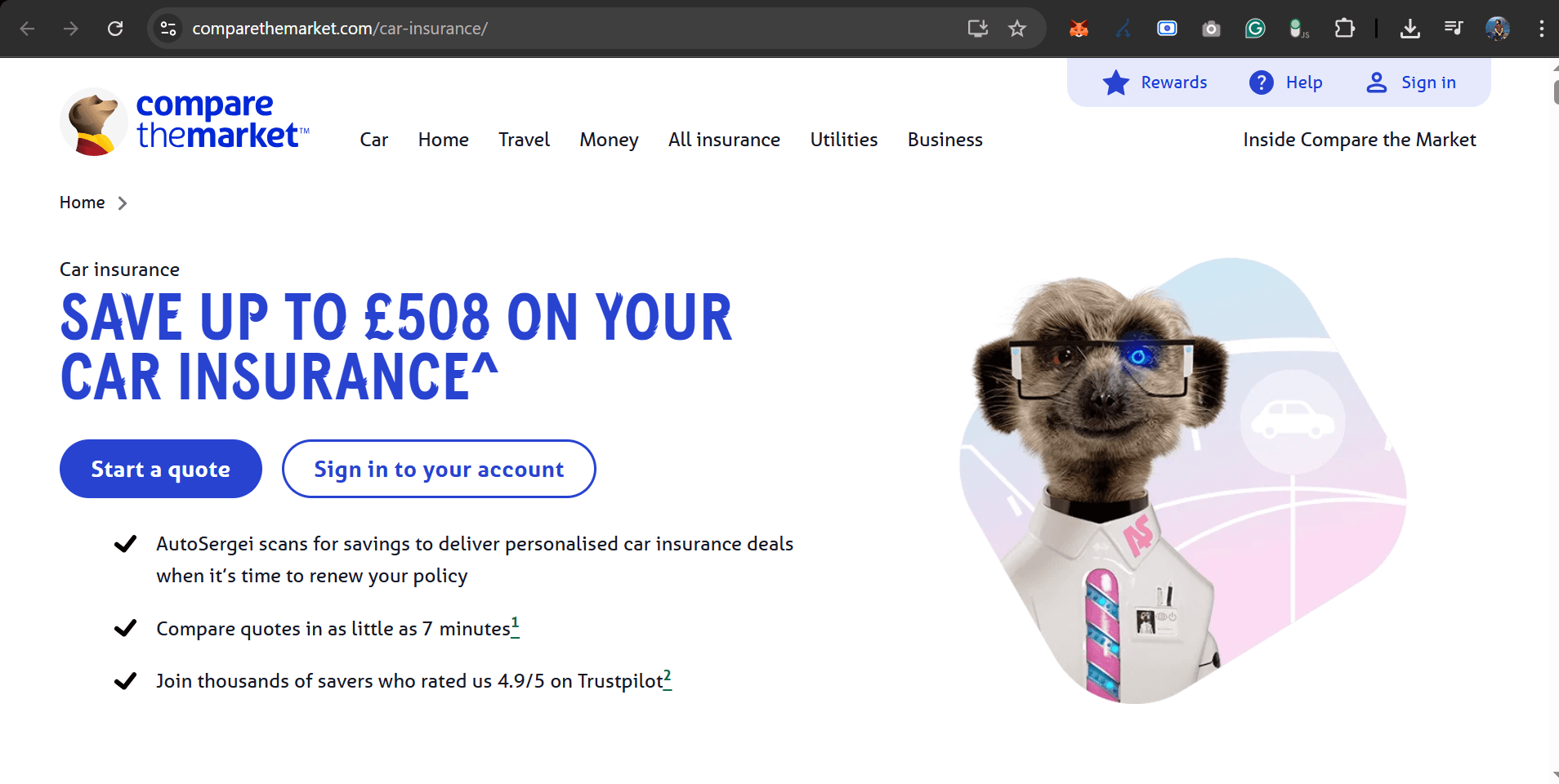
Real-world example: Compare the Market’s car insurance hub is a good example of hub-and-spoke SEO in action. The main car insurance page is supported by related guides around black box insurance, young drivers, business car insurance, pay-as-you-go insurance, insurance providers, and policy explainers. This creates a content ecosystem around one high-value commercial category.
3. Build pages around comparison intent keywords
This is the core. Users do not search for generic terms only.
They search for things like:
- Best car insurance UK
- Cheapest broadband deals
- Compare gas and electric prices
- Best savings accounts
- Best travel insurance for families
- Cheapest Nike trainers UK
- Best price for [product]
- [Product A] vs [Product B]
Every major comparison intent deserves a dedicated landing page.
Good page types:
| Page Type | Example |
|---|---|
| Category | Compare car insurance |
| Use case | Best insurance for young drivers |
| Brand comparison | Vodafone vs EE broadband |
| Price-led | Cheapest broadband deals |
| Best-buy | Best credit cards for rewards |
| Product comparison | Product A vs Product B |
Topical coverage wins here. The big brands rank because they cover thousands of these specific use cases — not because they have one generic page targeting a head term.
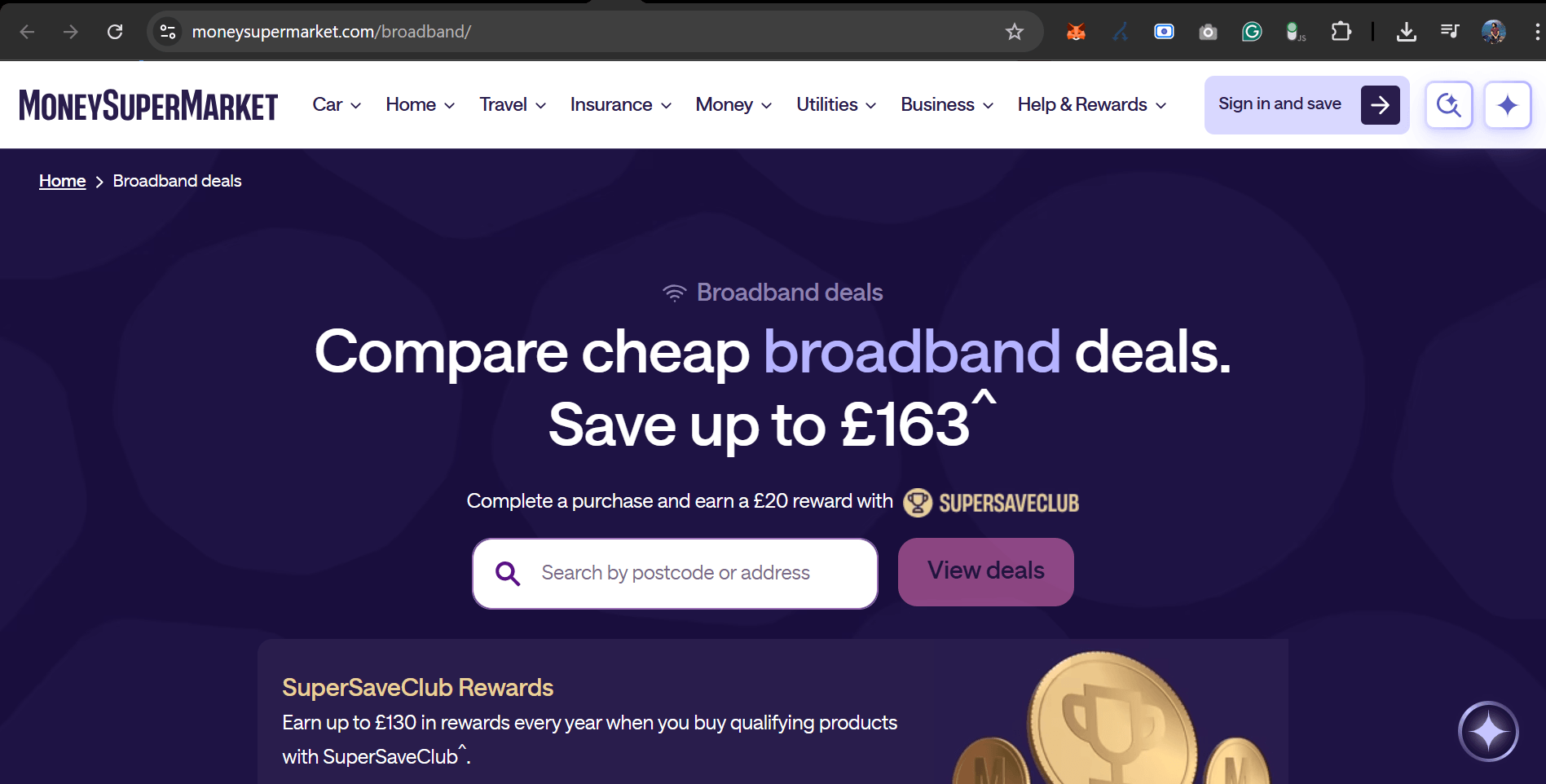
Real-world example: MoneySuperMarket’s broadband section is built around comparison intent, with pages and journeys for broadband deals, fibre broadband, broadband and TV, provider comparisons, postcode checks, and cheaper deal searches. MoneySavingExpert’s broadband comparison area also targets specific intent variations such as cheap broadband, social tariffs, broadband in your area, and switching advice.
4. Comparison tables are your SEO product pages
Comparison tables are effectively your product detail pages. The table is the most important SEO asset on a comparison page.
It should include:
- Price
- Monthly cost
- Features
- Ratings
- User reviews
- Contract length
- Pros/cons
- CTA
- Updated date
Google rewards highly structured content. Visual comparison layouts help both users and search engines, improving chances for:
- Featured snippets
- AI overviews
- Comparison rich results
- Higher CTR
The comparison table and CTA should appear high on the page. Organic traffic should be treated as a conversion funnel, not just a traffic source. The best-performing comparison pages balance search intent satisfaction with fast decision-making UX.
Creating proprietary tools such as calculators, savings estimators, or comparison widgets can also create high-value pages that naturally attract backlinks and improve engagement.
Metadata should be written around user value, not just keywords. Leading with potential savings, price comparisons, or benefit-led messaging can significantly improve organic CTR.
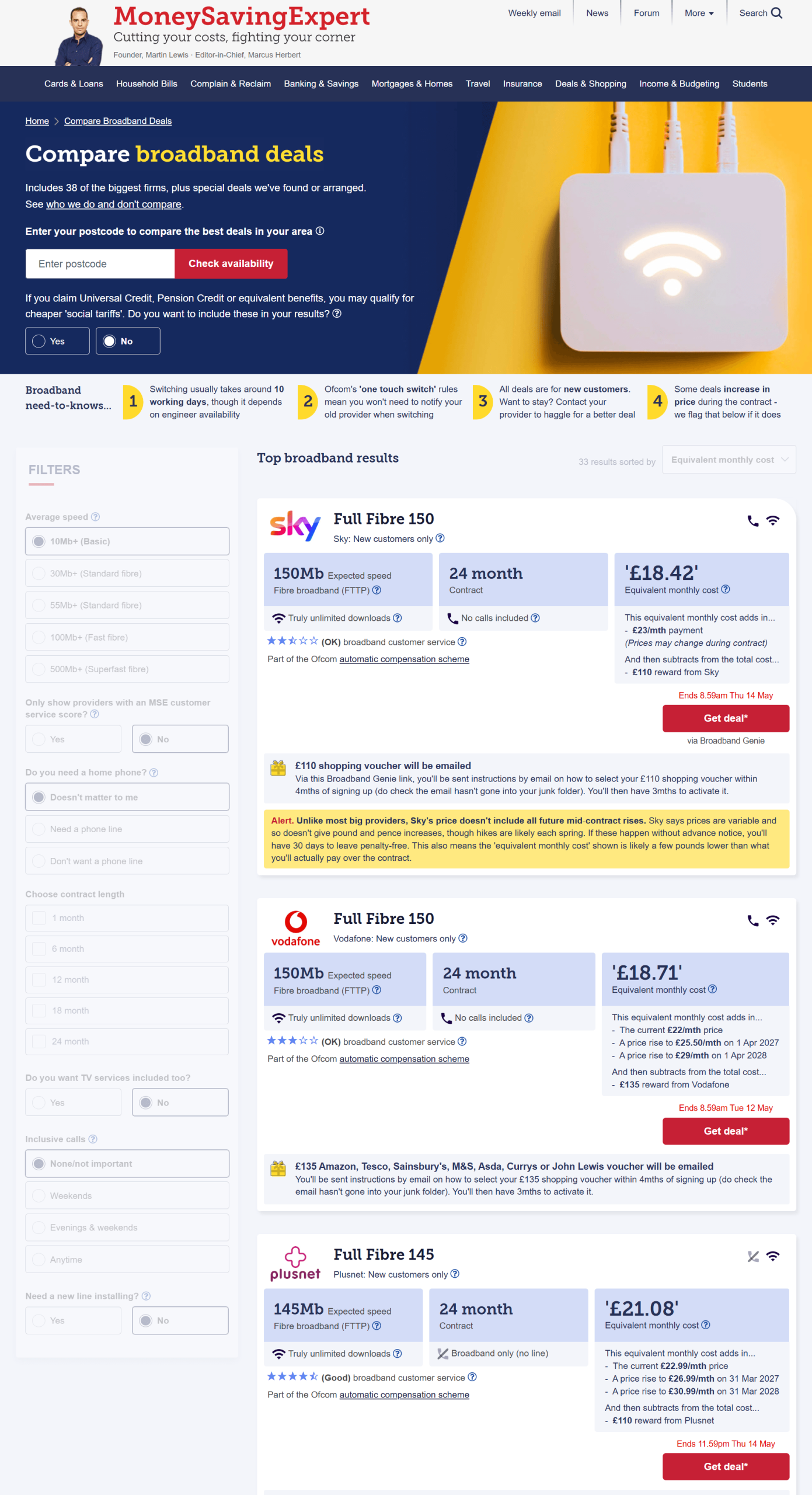
Real-world example: MoneySavingExpert’s broadband comparison tool shows how the comparison table becomes the main SEO and conversion asset. It combines provider details, pricing, deal information, availability checks, and user decision points in one structured experience. Compare the Market’s motoring comparison journeys also show how quote and comparison modules sit at the centre of the user experience.
5. Capture long-tail and informational queries
This is where newer players can beat big brands.
Instead of competing directly on “car insurance”, build clusters like:
- Best car insurance for new drivers under 25
- Cheapest black box insurance in London
- Compare temporary car insurance for 1 day
This long-tail cluster strategy compounds. The big brands rank because they cover thousands of these use cases at scale.
Users also search informational queries throughout the buying journey:
- How does black box insurance work?
- Does car insurance cover theft?
- What affects broadband speed?
- How much should home insurance cost?
These educational searches capture users at the top of the funnel and feed commercial conversion later in the journey. They also signal topical authority to search engines, which reinforces rankings on the high-intent commercial terms further down the funnel.
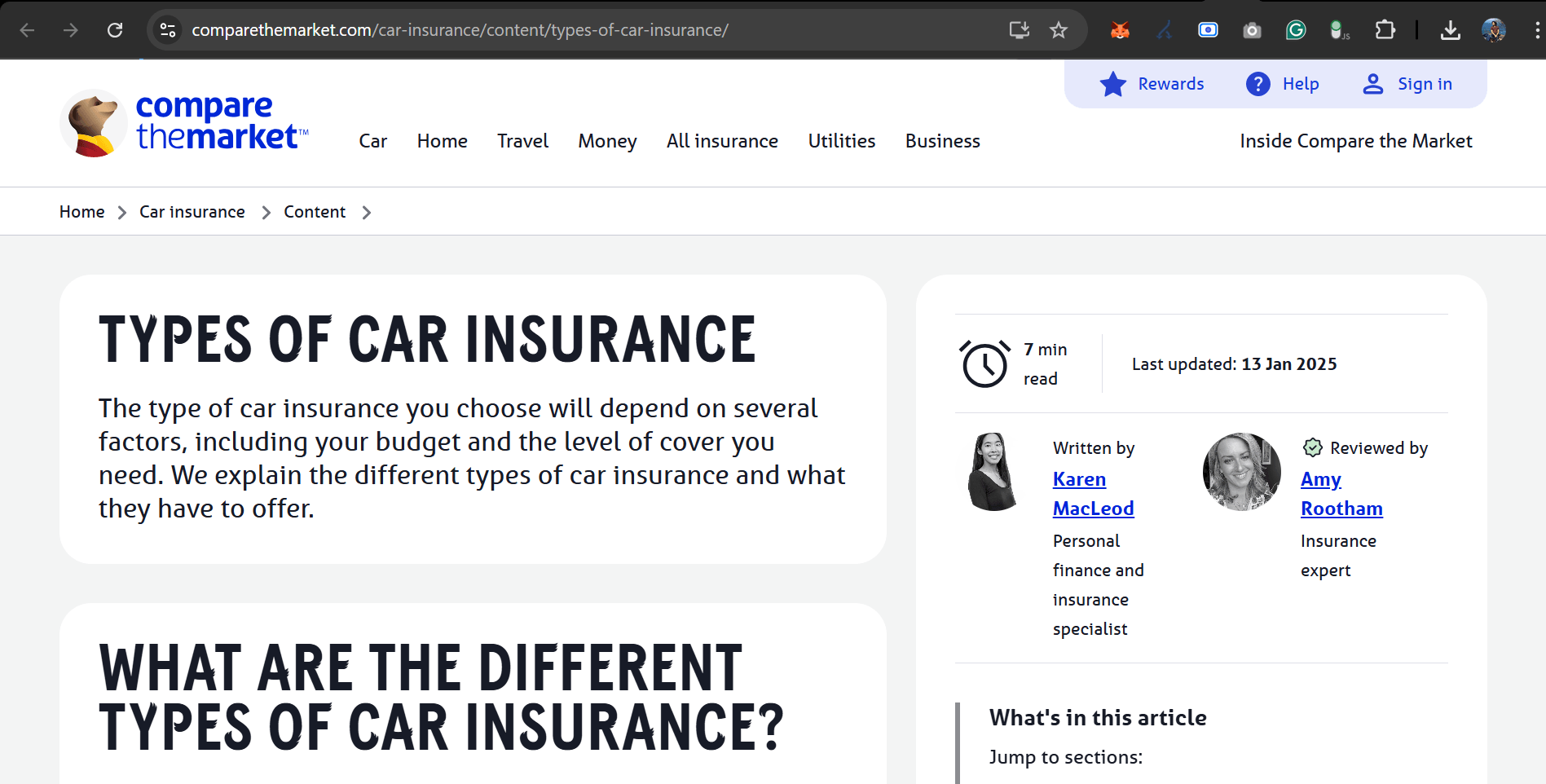
Real-world example: Compare the Market’s car insurance guides target informational searches such as types of car insurance, black box insurance, temporary insurance, and policy explainers. MoneySavingExpert’s broadband guides also do this well, using advice-led content to answer questions before pushing users toward commercial comparison tools.
6. Technical SEO and crawl efficiency
Comparison websites often generate huge numbers of URLs through filters, sorting, parameters, and dynamic page combinations. If Google cannot crawl those pages efficiently, they effectively do not exist.
Without strong technical SEO controls, crawl budget can be wasted on low-value or duplicate pages.
Key areas to prioritise:
- Canonical handling
- Parameter management
- Indexation control for thin pages
- Internal linking discipline
- Server-side rendering / fully indexable content
- Core Web Vitals and mobile performance
- Fast-loading mobile-first templates
Faceted navigation management is especially important. Low-value filter combinations should use canonical tags or noindex directives to prevent crawl bloat.
Page speed matters heavily in the finance and utility sectors. Faster quote journeys improve user trust, conversion rates, and SEO performance — every millisecond removed from a quote results page can improve engagement and quote completion rates.
Mobile UX deserves particular attention on the quote journey itself, not just the landing page. Most conversions happen on mobile, and forms with poor input handling, unclear progress indicators, or slow validation steps lose users before they complete.
Removed guides or outdated articles should be redirected to the closest relevant page rather than left as 404s, especially if they still have backlinks, internal links, or organic traffic.
Real-world example: MoneySuperMarket’s broadband pages and MoneySavingExpert’s broadband comparison tool both combine dynamic postcode or deal-based journeys with indexable landing pages. This is the balance comparison sites need: allow users to filter and personalise results, but keep priority commercial pages crawlable, fast, and indexable.
7. Data accuracy and feed management
For price comparison websites, data quality is part of SEO.
If prices, availability, links, product details, or provider information are wrong, users lose trust quickly. Broken links and outdated prices damage both conversion performance and brand credibility.
Use automated data feeds, supplier integrations, APIs, or controlled scraping processes to keep pricing, availability, and offer data accurate.
Key areas to manage:
- Accurate prices
- Current availability
- Working affiliate or provider links
- Correct product or policy details
- Clear last-updated dates
- Feed monitoring and error alerts
This is especially important when prices are being pulled into schema markup or comparison tables — incorrect structured data can result in manual actions or rich result removal from Google.
Real-world example: Compare the Market’s trusted partners page shows the importance of provider relationships and partner coverage. MoneySavingExpert’s broadband deals also highlight how deal information, cashback, voucher offers, pricing, and availability need to be regularly updated to remain useful and trustworthy.
8. E-E-A-T, editorial authority, and trust
This vertical sits firmly in YMYL territory when financial products are involved, and Google is highly sensitive to E-E-A-T (Experience, Expertise, Authoritativeness, Trustworthiness) signals here.
You must demonstrate:
- Editorial methodology: how rankings and recommendations are decided
- Affiliate disclosure
- Update timestamps
- Author expertise: who wrote it, who reviewed it, and why they are qualified
- FCA authorisation displayed clearly (for finance verticals)
- ICO registration and clear data handling
- User reviews and ratings to support decision-making
Without these, rankings will struggle. Content should ideally be written or reviewed by qualified financial experts wherever possible, with credentials shown on author bio pages.
The strongest performers in modern comparison SEO are no longer just quote engines or affiliate aggregators. They combine comparison functionality with editorial authority, community trust, expert-led financial education, and helpful content ecosystems.
This is one reason why editorial-first brands like MoneySavingExpert have continued to gain significant organic visibility over traditional comparison-only platforms. Editorial authority itself has become a major SEO moat — and this aligns closely with Google’s Helpful Content systems and the broader move toward experience-led search results.
Real-world example: MoneySavingExpert is one of the strongest examples of E-E-A-T in the UK comparison space. The site combines expert-led guides, editorial explainers, savings journalism, tools, community discussion, and clear consumer advice. That trust layer gives it a major SEO advantage over sites that only provide comparison tables without deeper editorial authority.
9. Brand authority and Digital PR
In highly competitive comparison verticals, links and brand demand are often as important as on-page SEO. The strongest players continuously invest in Digital PR, data studies, expert commentary, and media visibility to strengthen authority.
Focus areas:
- Data-led campaigns
- Original research
- Expert commentary
- Mainstream media coverage
- Brand search growth
Compare the Market benefits enormously from brand awareness through TV advertising and the Meerkat campaigns. High branded search demand acts as a major authority signal that strengthens visibility across generic non-brand keywords.
In insurance and finance, especially, links from high-authority publishers such as the BBC, Forbes, or The Guardian are often the currency of success.
Examples of effective Digital PR strategies:
| Strategy | How it works |
|---|---|
| Data Journalism | Publishing studies such as “The most expensive UK cities to insure a car” to attract media coverage and backlinks. |
| PR Campaigns | Using mascots, campaigns, or celebrity partnerships to generate social buzz and branded mentions. |
| Expert Integrations | Getting featured within finance advice columns and expert recommendation articles. |
Real-world example: Compare the Market is a standout example of brand-led SEO strength. The Meerkat campaign created huge brand recall, which supports branded search demand, trust, CTR, and repeat usage. MoneySuperMarket has also used high-profile brand advertising to build familiarity beyond pure search visibility.
10. Schema markup and structured data
Comparison sites rely heavily on structured data to surface in rich results. The core schema types to deploy:
- Product and Offer: for prices, availability, ratings
- FinancialProduct: for finance verticals (loans, credit cards, savings)
- AggregateRating and Review
- FAQ: captures long-tail questions and snippet visibility
- ItemList: for ranked comparison lists
- Breadcrumb: supports site structure understanding
- Organisation: for brand and entity recognition
Product and Offer schema help search engines understand prices, availability, ratings, and product details more clearly. Review and product schema can improve click-through rates significantly by enhancing visibility within the SERPs.
FAQ sections are especially valuable on comparison pages — they capture long-tail questions, support featured snippet visibility, and help users make decisions before starting a quote.
For finance products specifically, use structured product attributes wherever possible. The more precisely your data is described, the more likely it is to surface in comparison-style snippets and AI Overviews.
Real-world example: MoneySuperMarket’s home insurance pages are good examples of pages where structured information, such as providers, cover types, pricing messages, FAQs, ratings, and comparison lists, can be marked up clearly. MoneySavingExpert’s comparison tools also show how structured layouts naturally support schema types such as FAQ, ItemList, Product, Offer, and Organisation.
11. Optimising for AI Overviews and SGE
AI Overviews now appear on a significant share of finance, insurance, and comparison-related queries in the UK. Being cited within them is becoming as valuable as ranking position one.
To improve the chances of being cited:
- Use clear, direct answer formats near the top of pages
- Implement comprehensive schema (Product, Offer, FinancialProduct, FAQ)
- Build strong entity associations: Google needs to understand what your brand is known for
- Provide structured comparison data that can be synthesised easily
- Maintain authoritative author and reviewer signals
Recent market commentary already highlights AI as a potential disruptor in this space. Comparison sites that lean into AI-first user experiences – AI-generated summaries, “best option for me” filters, personalised recommendations — combined with strong structured data have a real opportunity to outperform legacy UX.
Real-world example: MoneySavingExpert’s broadband guides use direct answers, clear headings, practical advice, and structured recommendations, making them easy for AI systems to summarise. Compare the Market’s informational guides also use concise explainer formats that are well-suited to AI Overview-style extraction.
12. Content freshness and ongoing maintenance
Freshness signals matter enormously in comparison to verticals. Queries like “cheapest broadband deals 2026” or “best savings accounts” are explicitly time-sensitive, and Google rewards pages that are demonstrably maintained.
Maintenance priorities:
- Visible last-updated dates on every comparison page
- Regular review cycles for top commercial pages (monthly minimum)
- Refreshed pricing, providers, and offers as the market changes
- Removal or noindex of outdated seasonal content
- Re-promotion of refreshed pages internally and externally
A six-month-old “best of” page with stale offers signals neglect to both users and search engines. Treat top commercial pages as living assets rather than publish-and-forget content.
Real-world example: MoneySavingExpert’s deal pages are built around regularly updated offers, pricing, voucher information, and availability. Compare the Market’s insurance guidance also shows the need to keep pricing advice, provider information, and market context up to date.
13. Measure SEO by business outcome, not just rankings
For comparison websites, rankings alone are not enough. SEO performance should connect directly to quote starts, conversions, and revenue.
The most useful metrics:
- Non-brand clicks by category
- Quote-start rate
- Conversion rate from organic landing pages
- Indexation rate of priority pages
- Share of search visibility vs competitors
- Feed accuracy and broken link rate
- AI Overview citation share
Conversion Rate Optimisation (CRO) plays a major role in SEO performance for comparison sites. If users land on a page and immediately bounce back to search results due to poor UX or slow performance, search engines can interpret that as a poor experience signal.
The journey from search result → comparison page → quote engine should feel frictionless. Every step that adds friction loses both conversions and rankings.
Real-world example: Compare the Market’s customer rewards ecosystem shows how comparison brands connect SEO traffic to business outcomes such as repeat usage, retention, and conversion. MoneySuperMarket also treats organic traffic as part of a wider commercial funnel, with quote starts, comparison journeys, and customer acquisition sitting at the centre of the experience.
Conclusion
The biggest comparison sites do not just rank for keywords; they build authority across entire decision journeys and product categories. Modern challenger brands should think beyond comparison functionality alone and focus on becoming trusted information destinations within their niche.